The Procedure

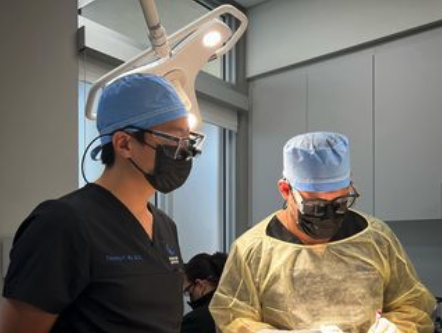
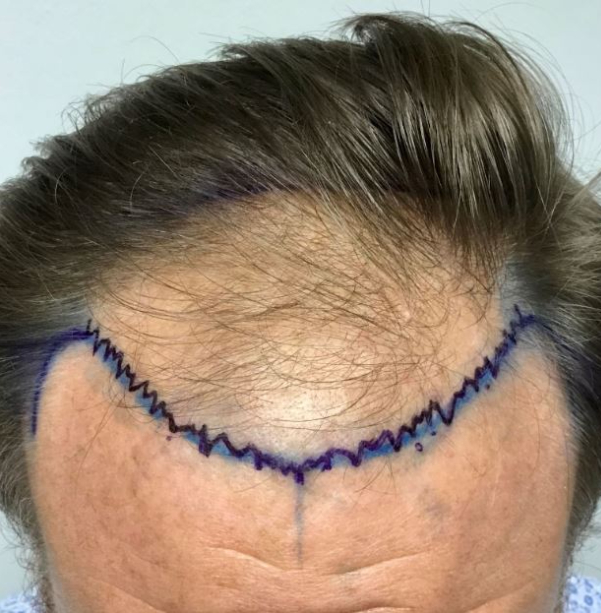
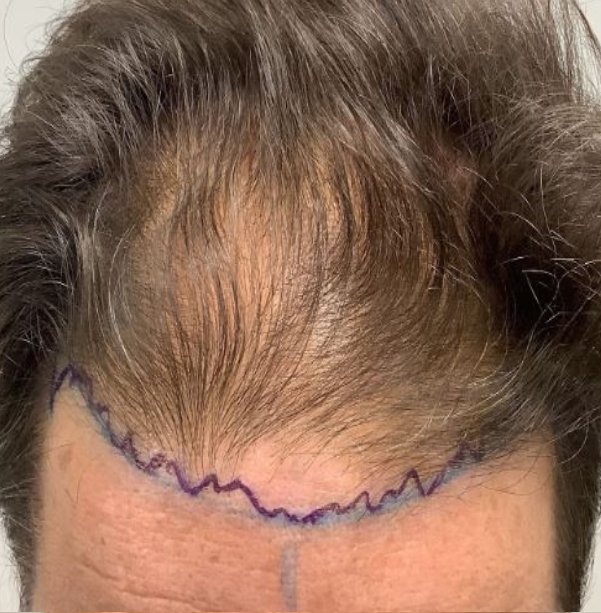
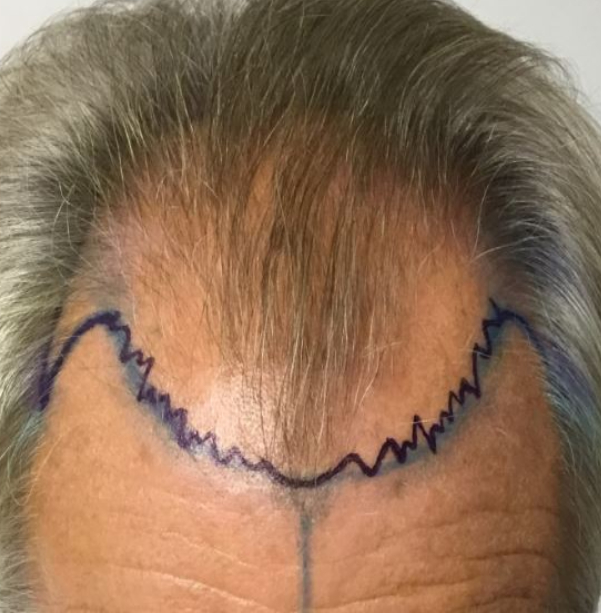
Upon arrival, you are escorted to a private treatment room where Dr. Nusbaum explains exactly what's going to happen. He outlines the area on your scalp he intends to transplant and proceeds only with your approval.

We provide medication to relax you and a surgical gown to wear during the procedure. A technician massages your scalp prior to administering local anesthesia. This massaging technique, developed by Dr. Nusbaum, is based on acupressure but involves no needles. The massaging creates a vibration in the skin that works in combination with the anesthesia to minimize any discomfort associated with the procedure.

While your scalp is anesthetized, the grafts are surgically removed from the donor strip at the back of your head and transplanted to the chosen sites. Most patients report experiencing minimal, if any discomfort during the procedure.

Click to read about post-procedure.


Hair Restoration Procedure Details


Strip Donor Procedure

Hair in the donor area is clipped to a 2 mm length. The hair above the donor sites  completely camouflage these areas immediately after the procedure. For such coverage, it is recommended that the hair in this area be left at least 1-1 ½ inches long for the procedure. The donor area and the recipient area (the area into which hair will be grafted) are anesthetized by injecting a local anesthetic with a very small gauge needle that is about the size of an acupuncture needle. Anesthetizing the areas is the only painful part of the session and the above technique usually causes less discomfort than a visit to the dentist.
   
After anesthetizing the donor area, a specially designed scalpel is used to remove a “strip” of hair bearing scalp from the donor area. This area is closed with the “LEDGE” trichophytic closure developed by Dr. Rose which allows hairs to grow through the scar to minimize its appearance. The “strip” is then divided under microscopes into small follicular units containing 1-4 hairs. Small slits which are no larger than those that would be created by an injection needle are made in the recipient area and the grafts are placed into these small openings. Bandages are avoided altogether. It is recommended that pain medication is taken the first night. The following day the patient returns to have the areas checked and shampooed.
   
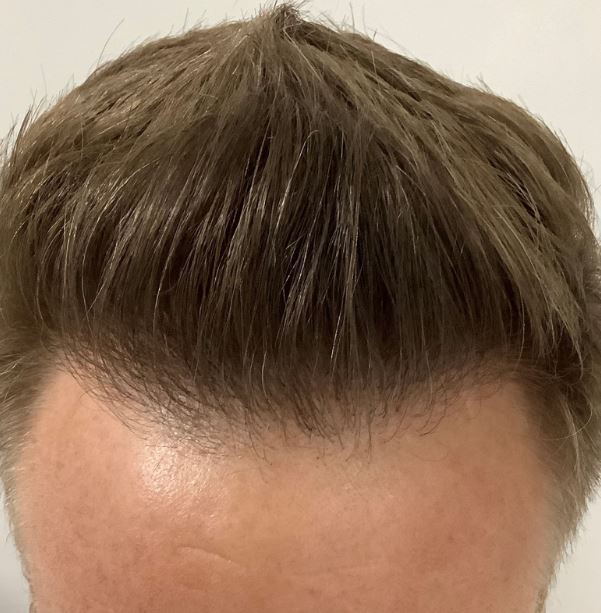
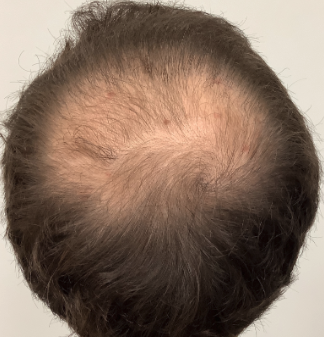
Generally, the front half of a balding area will require one session to produce satisfactory and natural-looking coverage. The back half or crown area can also be completed in one session. “Fill in” sessions can be done subsequently depending on the patient’s density objectives.
   
The number of grafts which should be transplanted at one session and the number and frequency of transplant sessions depend on the characteristics of each individual case; this will be planned out in advance for each patient. For example, coarse hair provides twice the coverage as compared to fine hair. The number of follicles that can be transplanted in one procedure depend on your individual donor characteristics such as scalp elasticity and follicle density. Generally, in order to obtain a greater number of follicles, a wider strip will be required and in some cases, this may result in a slightly wider scar. Our physician will assess these parameters and advise you as to what is optimal in your case.
 

Follicular Unit Extraction/Follicular Isolation Technique

Unlike for a strip, the entire scalp needs to be shaved for this type of donor harvesting. Follicular unit extraction (FIT) or (FUE) is a technique for removing follicular units from the donor area in a different way. It utilizes a small (0.8-1mm.diameter) circular knife called a “punch” to remove the units in a scattered array from the donor area.  It produces many tiny “dot like” scars instead of the line-scar that is produced by strip removal. In 90% or more of cases,  strip scar-lines are 2mm. wide, or less, and are only barely visible if you pass a comb upward through the donor area and look carefully. The advantage of FUE is that you may be able to wear your hair shorter in the donor area but, the FUE “dot” scars will still be visible if you shave your head. FUE is  time consuming  and  the cost for a procedure using FUE is 2.5 times more than when a strip is performed. One possible approach is to perform the transplantation utilizing strip removal and, later, if the patient wishes, a small session of FUE can be done to put hairs into the donor line scar to improve its appearance, if desired.

Patients often ask about the difference between strip harvesting and FUE/FIT follicular unit extraction/Follicular isolation technique. Here is some information that may help clarify these approaches. Please note that we offer both techniques.
 
Strip:
Advantages
  1. Able to harvest a large number of grafts in a short time
  2. Negligible damage to grafts, therefore increased survivability
  3. Lower Cost
  4. No need to shave head to harvest large numbers of grafts
  5. Multiple sessions can often be performed using the same scar
Disadvantages
  1. Results in a linear scar. With the “ledge closure” the scar may be extremely difficult to see and the patient can wear his or her hair quite short
 
FUE/FIT
Advantages
  1. A line scar is not created
  2. The patient will be able to wear his or her hair shorter than with a strip harvest
Disadvantages
  1. The donor area of the head must be completely shaved for the procedure
  2. Higher rate of damage to grafts and no survivability data available
  3. Thinning of the donor area if large numbers of grafts are obtained
  4. Scars that appear as tiny dots are visible if the hair is shaved
  5. More expensive
  6. Lower numbers of grafts can be obtained in one session so that multiple surgical

Days are required for large (>1500) graft requirements and there may be patient discomfort associated with the long operative time required.


Platelet Rich Plasma (PRP)

PRP is prepared by drawing a small amount of the patient’s own blood at the time of the transplant procedure. It concentrates your own growth and healing factors for use to enhance healing and growth in the hair transplant procedure. PRP has been shown to decrease redness and crusting following transplantation (Reese) and improves the percentage of growth of transplanted follicles (Uebel).
 

PRP References:

Reese, R. A single-blinded, randomized controlled study of the use of autologous platelet rich plasma (PRP) as a medium to reduce scalp hair transplant adverse effects. Hair Transplant Forum International, March/April 2008, 51-52
Statistically significant differences in scalp crusting and erythema     
At POD 5 and 10 for the PRP group vs. control
Uebel, C. A new advance in baldness surgery using platelet-derived growth factor. Hair Transplant Forum International, May/June 2005, Improvement in number of hair follicles in a PRP treated area compared to a non-treated area improved between 3 and 52% (avg 15%).